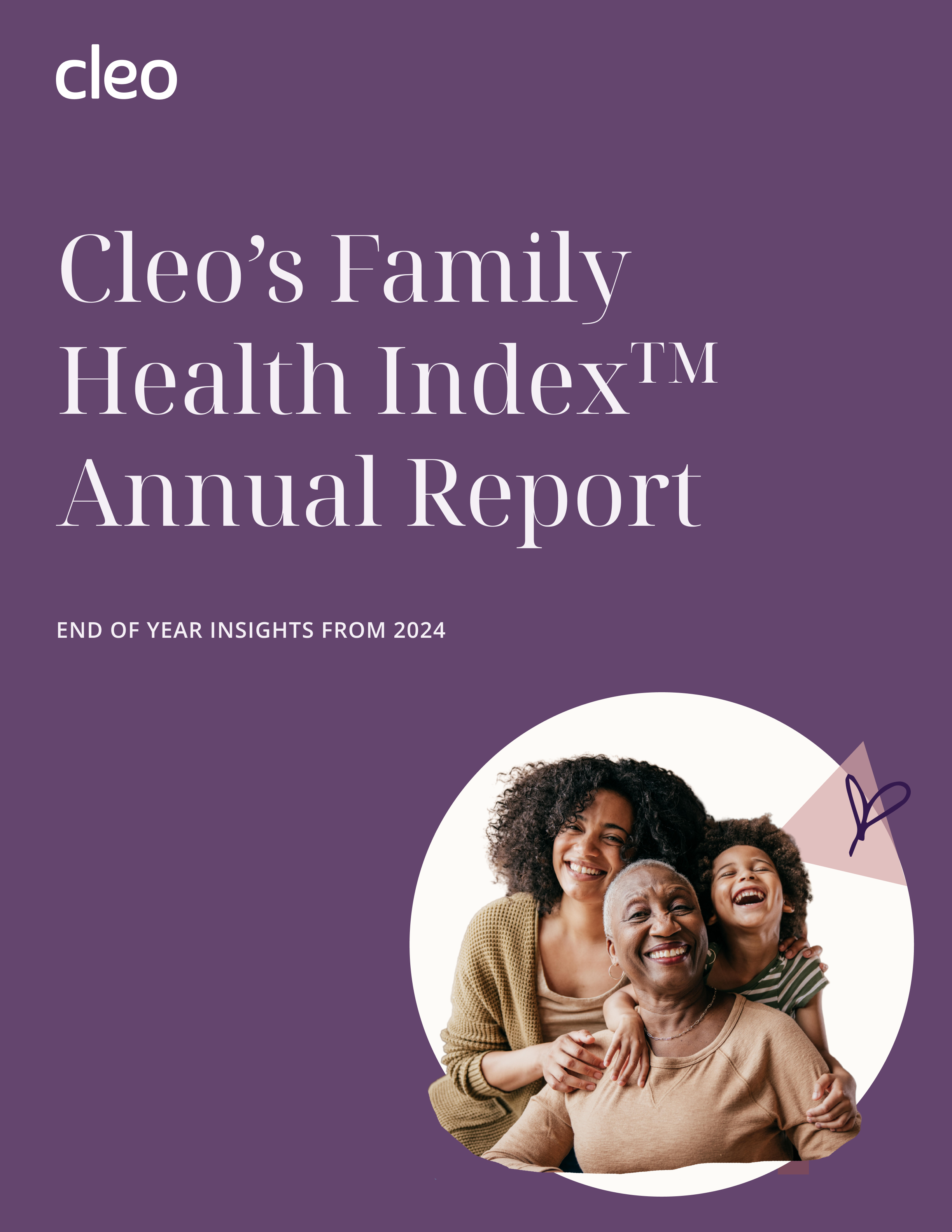
Download the latest Family Health Index Annual Report
Get your copy of the most up-to-date parenting and caregiving insights, to help your organization better support this essential population.

Cleo’s Family Health Index™ (FHI) — a unique measure of seven dimensions of family health and caregiver wellbeing — provides a detailed view of the state of working parents and caregivers. Data shows that members are often identified as high risk for burnout across all demographics. According to our 2026 report, 64% of working women in the sandwich generation face a breaking point due to escalating caregiving demands.
Beyond providing insight on the wellbeing of caregivers and their families at scale, the Family Health Index equips Cleo to identify individual parents and caregivers at greater risk of burnout and in most urgent need of intervention. Validated by the Validation Institute, the Family Health Index is a multidimensional, robust tool for tracking members’ health and wellbeing in order to provide targeted recommendations and interventions to improve their care and prevent burnout while reducing healthcare spend and productivity loss for employers.
Our proprietary tool evaluates seven dimensions of caregiver and family health: caregiving balance, self-care, general health, connectedness, emotional wellness, confidence, and family support.
By quantitatively measuring these dimensions, Cleo can identify members with high levels of risk for burnout, directly engage them before suffering the consequences of burnout, and track changes over time.
“Burnout” is often used as a general catch-all expression for worker fatigue. But it’s much more than that. The definition for “burnout” that Cleo uses is a state of physical, emotional, and mental exhaustion that negatively impacts one’s ability to show up for themselves, for work, or for others.
Burnout can include physical health effects, such as increased risk for diabetes or cardiovascular disease, emotional or psychological effects, such as insomnia or depression, and occupational effects, such as absenteeism or disability leave. As of 2026, high-risk caregivers identified through the FHI incur an average of $1,000 PMPM in healthcare costs, compared to $600 PMPM for lower-risk members.
Essential to the Family Health Index is continuous data collection through ongoing check-ins and assessments designed to monitor health and wellbeing and inform members’ care.
With the Family Health Index, Cleo has the ability to measure and track the overall health and wellbeing of the parents and caregivers we support. This enables us to identify members at greater risk of burnout and its consequences, and intervene to improve outcomes. Third-party analysis by the Validation Institute confirms that engagement with Cleo directly improves members’ FHI and Emotional Wellness scores, leading to higher productivity and lower medical costs.
“By making caregiver burnout visible and measurable in real time, our Family Health Index™ provides early insight into caregiver risk and enables proactive interventions to help organizations better manage costs, protect productivity, avoid preventable leaves, and build a more resilient workforce.”
Madhavi Vemireddy, MD, CEO of Cleo
Josh Freund, Senior Benefits Manager at Genentech, shares his perspective on Cleo’s Family Health Index: “There’s a really compelling case for why you’d want to get as many people into Cleo as possible. Because even if caregiving itself isn’t the top priority, risk identification is. And the Family Health Index does a great job of surfacing who might need more support—support Cleo provides, but also support we as benefits leaders need to think about more broadly in our systems.”
Cleo’s Family Health Index also shows that parents and caregivers whose company supports them in their caregiving journey are more likely to score higher, further corroborating that as employees receive family support, their overall health and wellbeing are impacted positively.
Download the 3rd annual (2026) report below to help your organization better support this essential population.
Curious about the historical data? Check out the previous reports here:
Get your copy of the most up-to-date parenting and caregiving insights, to help your organization better support this essential population.